Imagine you wake up to a violent overnight move in Bitcoin and need to decide quickly: exit a leveraged futures position, move collateral into a safe stablecoin, or stake leftover funds for yield while you wait. The technical steps — logging in, choosing between a custodial CEX wallet and the non-custodial Web3 wallet, and selecting a futures product — are trivial only until they aren’t. This article walks through the mechanisms behind OKX account access and futures trading, compares the trade-offs U.S. traders face, and highlights the operational and security limits you must acknowledge before pressing “confirm.”
The scenario is realistic because the tools are powerful: OKX combines a centralized exchange, a Web3 wallet, staking, and a DEX aggregator under one interface. That makes certain flows fast — but it also concentrates different risk models (custodial vs non-custodial, centralized clearing vs smart-contract exposure) in one place. Below I unpack how the login and account model works, how OKX futures are structured, where the real frictions and failure modes live, and how to choose a path that matches your goals and threat model.
How OKX account access and login work (mechanism)
At the most basic level, OKX offers two distinct access models that matter for both convenience and risk: a centralized account backed by the exchange (CEX) and a non-custodial Web3 wallet where you control keys. For the CEX account you create a username and password, complete KYC (US users must submit government ID and facial liveness checks), and enable mandatory two-factor authentication (2FA). OKX layers military-grade encryption and AI-driven login threat detection to identify suspicious activity; practically, that means unusual IPs or device fingerprints trigger additional verification or temporary blocks.
The non-custodial route gives you a local seed phrase and optional hardware wallet integration (Ledger, Trezor). Mechanically, the seed phrase signs transactions in your browser or device; OKX’s interface merely reads balances and forwards signed transactions. This separation matters: CEX custody means faster on-platform transfers, staking, and access to centralized derivatives. Non-custodial means you bear the full responsibility for backups and face smart-contract risk if you use DeFi features.
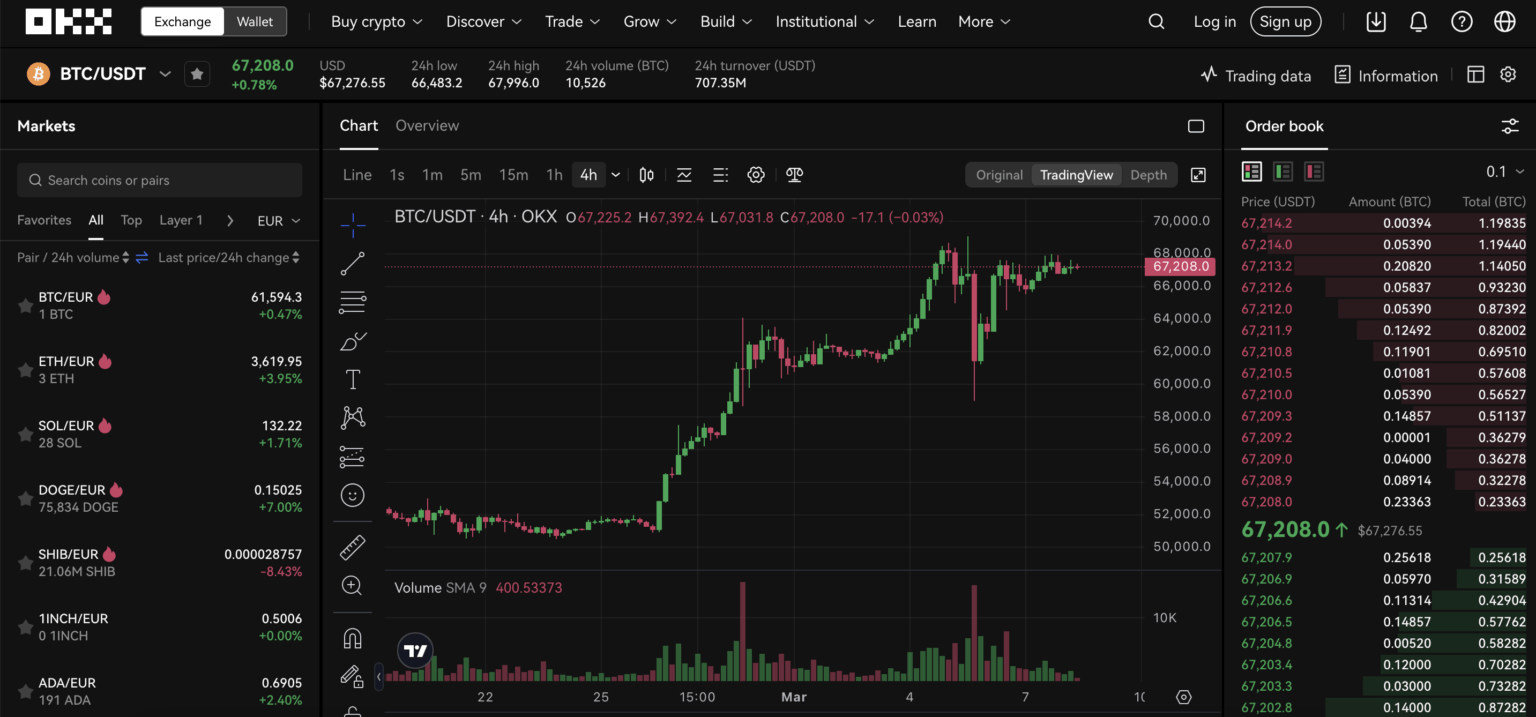
For hands-on help with the standard web login flow, OKX provides step-by-step guidance; a concise, operational link for users aiming to open their session quickly is available here: okx login. Use that if you want to follow the exchange’s cleaning of the login steps and device registration process.
OKX futures: structure, leverage, and the mechanics of execution
OKX’s derivatives suite contains quarterly futures, perpetual swaps, and options. Mechanically, perpetuals mimic spot through funding payments (small periodic transfers between longs and shorts that anchor the contract price to index price), while quarterly futures expire on set dates and settle against an index. The exchange offers up to 125x leverage for some futures on select assets — a design that magnifies both returns and liquidation risk.
Two execution mechanics deserve special attention. First, margin modes: isolated margin confines risk to a single position; cross margin pools your available collateral across positions. Isolated protects your wider account at the cost of faster liquidation on that position; cross gives survivability but can wipe multiple positions if the market gaps. Second, the liquidation engine uses mark price and maintenance margin thresholds; during dislocations, slippage and funding spikes can trigger cascades. Understanding these rules is operationally crucial if you trade with leverage.
Futures are attractive because they permit hedging and directional bets without moving spot assets. They are, however, dependent on an intact centralized clearing environment. OKX mitigates counterparty risk by storing over 95% of custodied funds in air-gapped cold wallets and publishing Proof of Reserves — transparency tools that let you verify a 1:1 backing on-chain. Still, that transparency does not remove market risk or the possibility of operational halts or delistings (for example, OKX recently delisted several low-liquidity pairs), which can affect hedges and basis trades.
Comparison: custodial CEX account vs non-custodial Web3 wallet for US traders
Below is a focused comparison of practical trade-offs — a decision-useful heuristic rather than platitudes:
- Speed and features: CEX wins. Immediate internal transfers, margin/futures markets, staking with auto-compounding, and fiat rails are native. Use this if you need rapid execution and want access to OKX’s derivatives and staking products.
- Control and sovereignty: Web3 wallet wins. You keep private keys and can integrate hardware wallets. Use this if custodial exposure is unacceptable or if interacting with DEXs and cross-chain bridges matters more than derivatives features.
- Security model: CEX: institutional-grade protections and multi-sig cold storage reduce theft risk, but you face custodial counterparty risk and phishing threats targeting logins. Web3: no custodial risk but total loss if seed phrase is lost or if you approve malicious contracts.
- Regulatory friction: CEX requires KYC; non-custodial interactions do not involve exchange KYC but may be constrained by network-level controls or bridge compliance. For U.S. residents, plan for identity checks and limits on fiat operations when using a centralized account.
Where the system breaks: limits, edge cases, and common failure modes
Several realistic failure modes are common and actionable. First, account takeovers via phishing remain the most consistent user-level threat: attackers mimic login screens, request 2FA codes, or trick users into signing transactions. Second, liquidation cascades in low-liquidity futures during sudden volatility can create slippage beyond expected loss models. Third, the hybrid risk of moving assets between CEX and non-custodial wallets exposes you to on-chain bridge risk and potential smart-contract bugs.
Regulatory uncertainty is another practical limit. Exchanges may delist pairs (as OKX recently did with several low-volume tokens), which can strand capital or change portfolio risk. KYC procedures can delay access to funds, especially during suspicious activity flags or high-volume withdrawal requests. These are not hypothetical: operational delays are a functional constraint on real-time risk management.
Decision framework — which path to choose in common trader profiles
Here are three short heuristics for U.S. traders:
- Active derivatives trader (intraday, high leverage): Use a verified custodial account with strict 2FA, hardware-backed login where possible, and conservative cross-position monitoring. Keep reserve collateral in cold storage off-exchange for tail events.
- Yield-focused allocator (staking, DeFi farming): Use a non-custodial Web3 wallet for DeFi interactions and only bridge minimal capital to CEX staking products when you need auto-compounding ease. Treat smart-contract interactions as a separate risk bucket.
- Hedger with occasional futures use: Use hybrid flows — keep spot and settlement collateral on the CEX for speed, but maintain a hardware-backed wallet for long-term holdings and cross-chain needs. Reconcile position sizing to maintenance margin and monitor funding rates.
What to watch next (short-term signals and conditional implications)
Monitor these signals because they change the calculus of custody and trading: funding rate spikes (signal shifting leverage demand), delisting announcements or liquidity withdrawals (affects hedging basis), and shifts in Proof of Reserves or cold wallet procedures (affect counterparty trust). Regulatory moves that affect fiat on-ramps or KYC standards in the U.S. would materially change accessibility and timing for large withdrawals; if such moves increase, expect tighter withdrawal controls and more identity checks.
Finally, fee and product mix changes at exchanges can nudge traders toward either centralized or decentralized tooling. If exchanges reduce leverage or tighten margin rules, some strategies will migrate on-chain — but only if cross-chain liquidity and reliable bridges scale without introducing comparable new risks.
FAQ
Do I need KYC to use OKX for futures trading in the U.S.?
Yes. Account creation for U.S. users requires Know Your Customer (KYC) verification, including a government ID and facial liveness check. KYC is necessary to access fiat rails, enable withdrawals, and use derivatives on a custodial account.
Is it safer to keep funds in OKX’s custodial account or in a private Web3 wallet?
“Safer” depends on your threat model. Custodial storage offers institutional protections and Proof of Reserves, reducing theft risk for average users but introduces counterparty risk. A non-custodial wallet gives you total control: if you lose the seed phrase or approve a malicious contract, recovery is impossible. Both require different operational disciplines.
How does liquidation work on OKX futures, and how can I avoid unexpected liquidations?
Liquidations occur when your margin falls below maintenance thresholds calculated using mark price. Use isolated margin for risky, standalone positions; set stop-loss orders sized to account for slippage; and keep buffer collateral or use lower leverage. During extreme volatility, markets can gap past stops, so position sizing is the primary defense.
Can I move assets between OKX’s CEX account and the Web3 wallet instantly?
Internal transfers within a custodial account are fast. Moving between the CEX and an external Web3 wallet requires on-chain transfers, which take time and incur gas/bridge costs. For urgent hedges, rely on internal transferability or pre-position collateral on both sides.